Bitcoin Casinos in Canada in 2026: How Crypto Gambling Laws, Payment Speed and Provably Fair Games Actually Work — and How to Pick a Trusted Platform Like Palomar

My short version of Bitcoin gambling in Canada in 2026: legal to play, awkward to regulate, and confusing for basically anyone doing it for the first time. Players keep drifting off the legacy sportsbooks and card-based casinos toward crypto-native sites. The reasons are practical. Faster withdrawals. Fewer bank headaches. Games you can check yourself.
I've spent a lot of time poking at how these platforms actually work, and it keeps landing on three pillars. The law — who really regulates what up here. Payment mechanics — why Bitcoin moves differently from Interac or a Visa card. Provably fair tech — what those 'fair' badges prove, and what they quietly don't. After that, I'll hand you a checklist and run Palomar through it as a worked example.
The Legal Landscape: How Crypto Gambling Is Actually Regulated in Canada in 2026
Gambling law in Canada is provincial in practice, not federal. The Criminal Code sets the baseline by banning unlicensed gambling operations, then leaves the provinces to run, license and police gambling inside their own borders. That's why the experience in Ontario looks nothing like the one in Québec or British Columbia.
Ontario's iGaming model is still the reference point in 2026. Private operators can be licensed and regulated there, with clear standards on advertising, player protection and dispute handling. Most other provinces lean on a government-run platform instead. The result is a patchwork.
Which matters, because a Bitcoin casino running offshore is easy to reach from your phone and usually isn't licensed by your province. There's the distinction people trip over: legal to play is not the same as licensed in your province. If something goes sideways, your recourse may be limited to the operator's own complaint process and whatever its foreign licensor decides to offer you.
Provincial Rules vs. Federal Law: Who Governs What
Descriptive, not legal advice — but the split looks roughly like this:
- Federal (Criminal Code): defines the offences around operating unlicensed gambling businesses and leaves enforcement mostly to criminal law, not day-to-day player protection.
- Provincial regulators: bodies like the AGCO and iGaming Ontario, Loto-Québec, and BCLC license, run or oversee gambling in their territories.
- Offshore licensors: jurisdictions such as Curaçao, Malta or the Isle of Man issue licenses that matter for the operator, but they don't replace a provincial licence.
What Canadian Players Should Verify Before Depositing
Before you send a single satoshi, run this short list:
- Licensing jurisdiction and license number: is it published, and can you look it up on the regulator's own site?
- KYC/AML policy: legitimate platforms verify identity, especially on larger withdrawals. No policy at all is a warning sign.
- Provincial eligibility: does the site explicitly accept players from your province?
- Responsible-gambling tools: deposit limits, cooling-off periods, self-exclusion.
- Dispute-resolution terms: who handles complaints, and how long do they take?
Payment Speed: Why Bitcoin Beats Cards and Bank Transfers
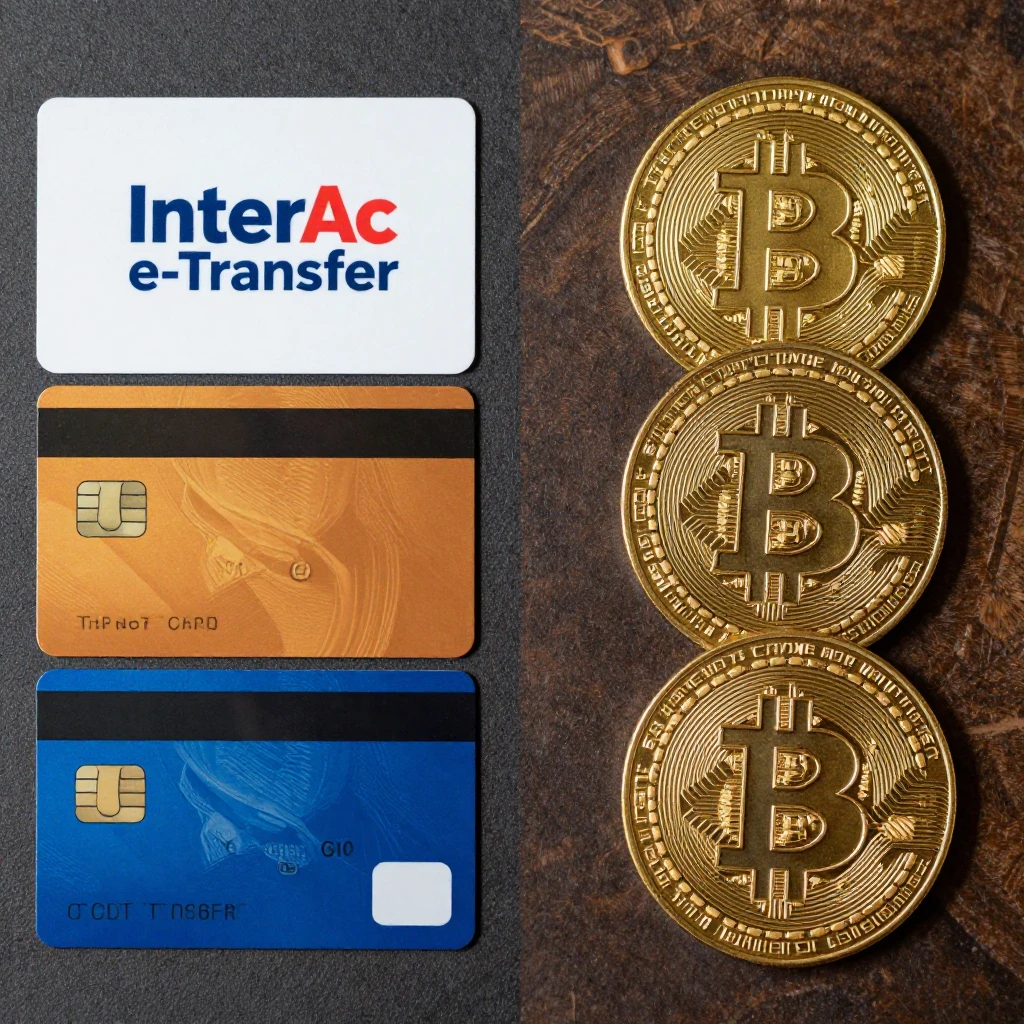
Deposits are where most people notice the difference first. An Interac e-Transfer is quick, but it still depends on the casino's processor and sometimes gets parked for review. Card deposits can be instant — except plenty of Canadian banks block or flag gambling transactions outright. On-chain Bitcoin usually credits after a few network confirmations. Often 10 to 30 minutes, depending on congestion and the site's rules. Lightning payments, where supported, settle in seconds.
Withdrawals are where crypto's advantage gets biggest. Traditional casinos commonly impose a 1 to 5 business day hold, plus a pending period, before money even starts moving. With Bitcoin, once the casino approves the payout, funds can land in your wallet within the hour. The approval step is still the bottleneck. So a platform's stated processing time matters as much as the blockchain itself.
Fees work differently too. Cards can carry foreign-exchange markups and cash-advance charges if the casino bills in another currency. Bitcoin has network fees, which move with congestion but stay flat relative to the amount. Which means they hurt small transfers more than large ones.
The Honest Trade-Offs
- Irreversibility: a blockchain transaction can't be charged back. Send to the wrong address and it's gone.
- Price exposure: converting CAD to BTC means your balance can move in value between deposit and withdrawal, even if you never place a bet.
- Bank friction: some Canadian banks flag or delay purchases at crypto exchanges, so plan for that when funding.
If you'd rather compare deposit methods, limits and processing times side by side before committing, a dedicated bitcoin casino canada resource is a sensible place to start. Seeing those numbers in one table makes it much easier to spot platforms that advertise 'instant' and then quietly cap or delay payouts.
Provably Fair Games: What the Technology Actually Does
Provably fair sounds like marketing. The mechanism is straightforward though. Three inputs combine: a server seed (the casino's secret), a client seed (yours), and a nonce (a counter that climbs with each bet). The casino publishes the hash of its server seed before you play, which locks it in. After the round, the real server seed gets revealed, and you check it against that hash. If they match, the casino couldn't have swapped the seed after seeing your bet.
Worth separating this from a 'certified RNG.' A certified RNG means a third-party lab audited the random number generator and the game's math. Provably fair gives you cryptographic proof for individual rounds. Different problems. A strong platform may offer both.
How to Verify a Round Yourself
- Before playing, copy the hashed server seed the site displays.
- Note your client seed and the starting nonce.
- Play your rounds, then rotate the seed so the casino reveals the original server seed.
- Hash the revealed seed with SHA-256 using an independent tool and compare it with the hash you copied.
- Re-run the game's formula with the seeds and nonce to confirm the outcome.
One caveat. This proves the roll or shuffle wasn't tampered with. It says nothing about the payout percentage. Return-to-player (RTP) is a separate question, answered by the game's published math and independent audits.
Red Flags in 'Fairness' Claims
- No server seed hash published before play.
- Seeds the player can't change or rotate.
- Verification that only works inside the site's own widget, with no way to check it independently.
- Marketing that treats 'provably fair' and 'licensed' as the same thing. They aren't.
Building a Trust Checklist for Choosing a Platform
Here's how I turn all of the above into a scoring framework. Give each item a simple pass, partial or fail:
- Licensing and ownership transparency: named operator, license number, verifiable registry entry.
- Payment breadth and withdrawal speed: BTC plus other options, clear limits, realistic processing times.
- Provably fair implementation: published hashes, seed rotation, independent verification.
- Game-provider quality: recognised studios, not anonymous clones.
- Bonus terms: reasonable wagering and cashout caps.
- Mobile experience: fast, stable, usable cashier on a phone.
- Support responsiveness: test it with a question before depositing.
- Responsible-gambling tooling: limits, timeouts and self-exclusion that actually work.
Reading Bonus Terms Without Getting Burned
Bonuses are where players lose the most money without noticing. Look for these clauses:
- Wagering multipliers: 35x on bonus plus deposit is far harsher than 35x on the bonus alone.
- Game-weighting tables: slots may count 100% while table games count 10% or nothing.
- Expiry windows: a 7-day deadline on a large rollover is a trap for casual players.
- Withdrawal caps: 'free' crypto bonuses often limit what you can cash out, however much you win.
Applying the Checklist: Where Palomar Fits
Palomar makes a useful example because it's Québec-facing, which puts provincial context front and centre instead of hiding it. I'd evaluate it against the checklist rather than just reading down a feature list.
On payments, check which Bitcoin and alternative deposit routes it supports, what the minimums are, and what processing times it states for withdrawals. On fairness, look for provably fair titles and confirm the seed hashes are visible and rotatable. On licensing, find the operator and licence disclosure and verify it independently instead of taking the badge at face value. On player protection, confirm deposit limits, session reminders and self-exclusion exist before you sign up. And read the bonus terms with the clauses above in mind.
None of that is a verdict, and you should reach your own. The point is simpler: a platform worth using makes every one of these items easy to find. One that buries them has already told you something.
Common Mistakes Canadian Crypto Gamblers Make
- Depositing before checking provincial eligibility. Check first, fund second.
- Skipping seed verification. The feature only protects you if you use it at least occasionally.
- Chasing bonus wagering they can't clear. A bonus you can't cash out is just a delay.
- Ignoring BTC volatility on CAD budgets. A 5% price swing can matter as much as a bad session.
- Treating 'unlicensed offshore' as 'unregulated, so nobody's watching.' Operators, payment processors and exchanges still face scrutiny, and you have fewer protections, not more.
FAQ
Is Bitcoin gambling legal in Canada in 2026?
Players generally aren't the target of Criminal Code offences, but operating unlicensed gambling is. Provinces license their own markets, so being allowed to play isn't the same as being protected by a local licence. Confirm your province's rules.
Do I pay taxes on crypto casino winnings?
Casual gambling wins are generally not taxed as income in Canada, but crypto gains or losses from holding and trading Bitcoin can be taxable events. Check with the CRA or an accountant for your situation.
How fast are Bitcoin withdrawals really?
After the casino approves the request, on-chain payouts usually arrive within minutes to an hour, and Lightning in seconds. Approval and KYC checks are the real variable.
What does provably fair mean in one sentence?
It means you can cryptographically check that a game result was fixed before you bet and wasn't altered afterwards.
Which province has the strictest rules?
Ontario has the most detailed licensed-operator framework, while provinces with government-run monopolies, such as Québec, restrict the market in a different way. 'Strictest' depends on whether you mean operator standards or market access.
Can I play with CAD, or do I need to buy Bitcoin first?
It varies by platform. Some accept CAD through other methods, while true crypto casinos expect BTC. Remember that converting CAD to BTC exposes you to price movement.
Conclusion
The framework comes down to three habits. Know your province's rules. Understand why payment rails affect your money, your timing and your risk. Verify fairness claims instead of trusting badges. Keep that checklist-first mindset and you'll end up on a platform you can actually audit, not one that just looks polished.
Gamble responsibly: you must be of legal age in your province (19+ in most), set limits you can afford, and confirm your local rules before you play. If gambling stops being fun, use self-exclusion tools or contact your provincial support line.